
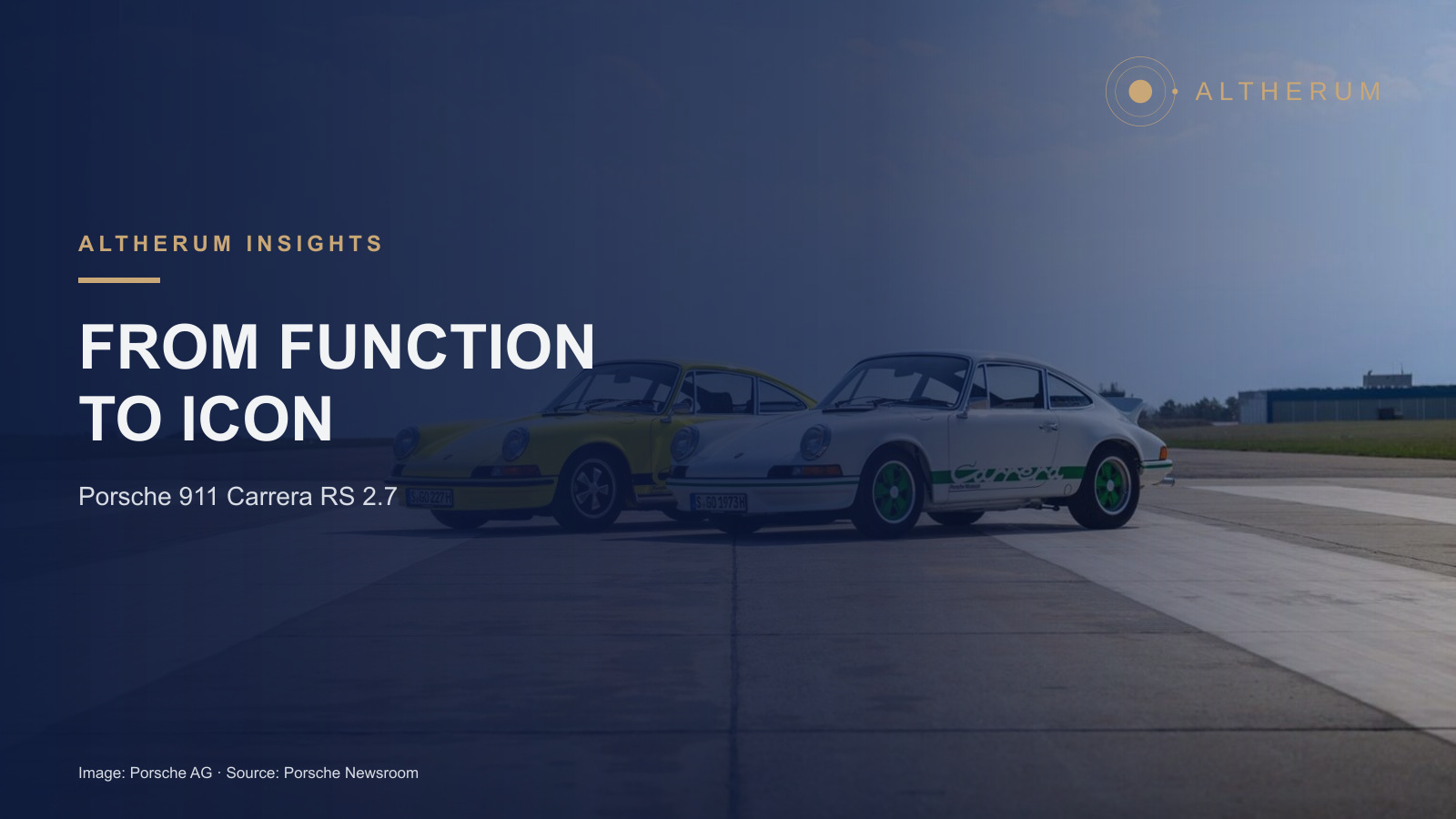
The Porsche 911 Carrera RS 2.7 was not created to become a collectible. It was created because Porsche wanted to race.
In 1972, the company needed a road-legal homologation model for Group 4 competition. The plan was to build 500 examples: enough to satisfy the rules, light enough to perform and focused enough to become the basis for racing and rallying. What followed was larger than the original production objective. Porsche presented the car at the Paris Motor Show on October 5, 1972. By the end of November, the first 500 had sold. Production ultimately reached 1,580 cars.
That sequence explains much of the RS 2.7’s enduring appeal. It was born from a specific purpose, recognized immediately by customers and produced in numbers that were meaningful but still limited. More than five decades later, it remains instantly identifiable.
Purpose came before image
The Carrera RS 2.7 was developed as a very light, fast sports car. Porsche reworked weight, aerodynamics, engine and chassis rather than relying on decorative distinction.
The lightweight Sport version had a curb weight of 960 kilograms. Rear seats, carpets, the clock, coat hooks and armrests could be removed; lightweight seat shells replaced heavier seats. Wider rear wheels improved traction. The 2.7-liter fuel-injected flat-six produced 207 horsepower in the U.S. specification described by Porsche Newsroom, allowing the Sport version to accelerate from zero to 62 mph in 5.8 seconds.
These details matter because they establish a coherent object. The car’s appearance, mechanical specification and intended use all point in the same direction. For collectors, that coherence is often more durable than rarity alone.
The ducktail: when engineering became a signature
The most famous feature was designed to solve an aerodynamic problem. Porsche engineers sought to reduce lift while preserving the closed shape of the 911. Wind-tunnel and track testing led to a rear spoiler whose raised profile became known as the “ducktail.” It supplied additional cooling air to the rear-mounted engine and, according to Porsche, reduced drag enough to increase top speed.
The Carrera RS 2.7 became the first series-production car fitted with both front and rear spoilers. A functional intervention became a visual signature, and the signature outlived the original technical brief.
This is one of the clearest ways design creates collector relevance. An object becomes memorable when a solution is not only effective but legible. The ducktail tells the story of the car before the engine starts.
Scarcity with a hierarchy
Porsche built 1,580 examples, but they were not all identical. The official production breakdown includes 200 lightweight Sport versions, 1,308 Touring versions, 55 racing cars and 17 base vehicles.
That hierarchy is essential. A production total does not by itself define the scarcity of every surviving example. Version, specification, condition, originality, history and documentation shape the market’s assessment of a particular car. Two RS 2.7s can share a model name while presenting materially different collector propositions.
The wider lesson applies across collectible assets: scarcity must be specific. “Rare” becomes meaningful only when the market understands what is scarce, why it matters and how the individual object relates to the recognized history of the category.
Motorsport relevance strengthened the narrative
The RS 2.7 was not an isolated styling exercise. It provided the base for a competition program. Porsche’s RSR derivatives achieved major results, including a 22-lap victory at the 1973 24 Hours of Daytona and success at the Targa Florio. Those results connected the road car to documented performance rather than retrospective storytelling.
The Carrera name reinforced the link. Porsche drew it from the Carrera Panamericana, where the company had achieved class success in the 1950s. “RS” stood for Rennsport, or racing sport. Name, engineering and competition record therefore formed one continuous identity.
What the RS 2.7 teaches about collectible value
The car demonstrates four durable value drivers.
First, purpose: it was built to meet a real competitive requirement. Second, recognizable innovation: the ducktail made engineering visible. Third, bounded production: 1,580 cars created a finite population with meaningful internal distinctions. Fourth, cultural continuity: later Porsche models repeatedly returned to the Carrera and RS language, strengthening the historical importance of the original.
None of these elements guarantees future appreciation. Collector markets are selective, transaction costs matter and the quality of the individual example remains decisive. But together they explain why certain objects continue to attract attention across generations.
For Altherum, the relevant question is never simply whether a famous model is desirable. It is whether a specific object combines authentic historical purpose, recognizability, meaningful scarcity and sustained collector depth. The RS 2.7 offers an unusually clear answer: function created the form, competition validated the idea and time transformed both into an icon.
Explore more Altherum insights on real assets and collectibles.
Sources and methodology
Porsche Newsroom, “Fifty years of the Porsche 911 Carrera RS 2.7”, published May 25, 2022 and accessed September 21, 2026. Production, specification, aerodynamics and competition facts are drawn from Porsche’s official historical account. Interpretations concerning collector relevance are Altherum editorial analysis.
This editorial content is for general information only. It is not investment advice, a valuation, an offer or a solicitation. Collectible assets may be illiquid and may lose value.