
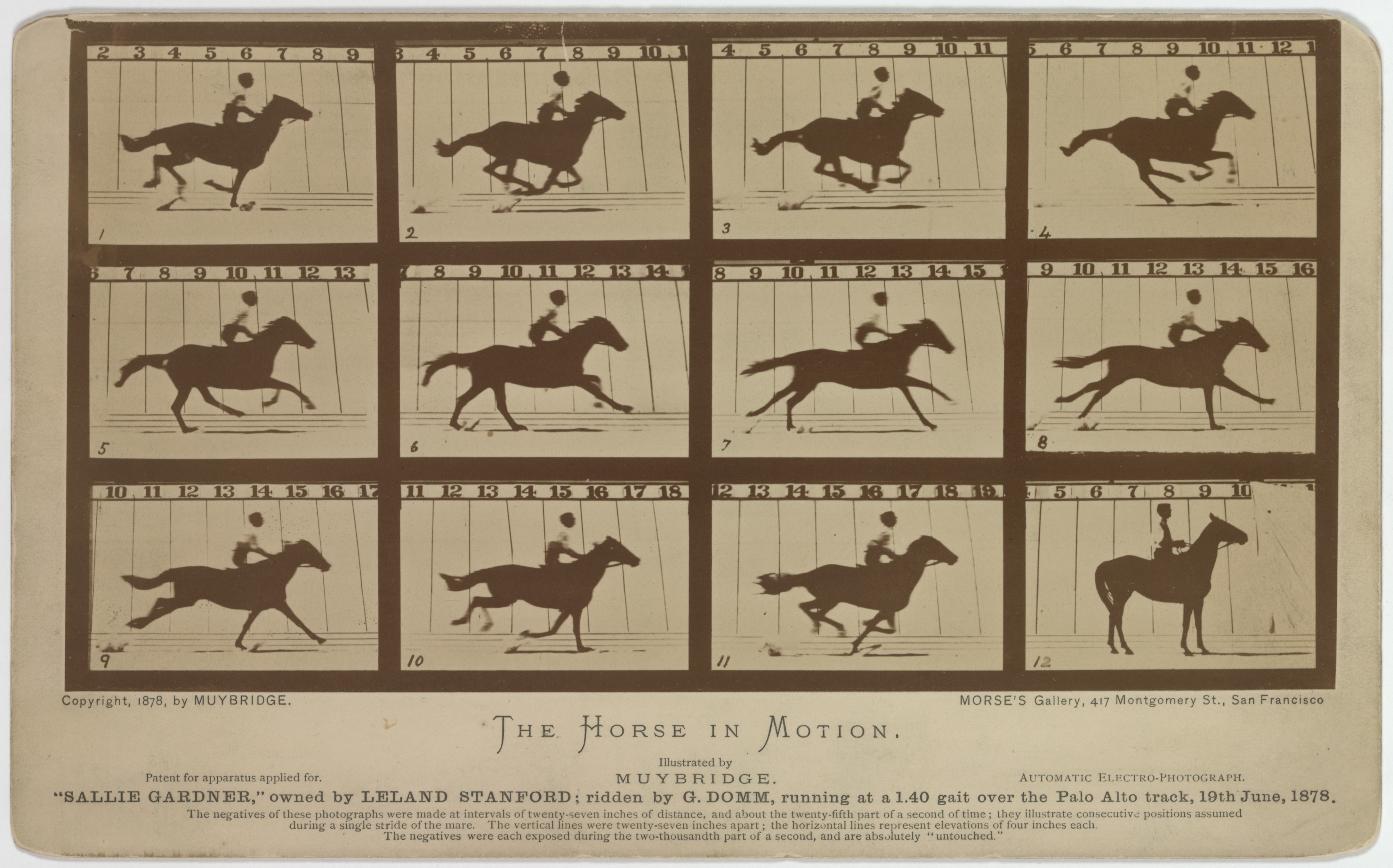
A horse gallops. We think we know what that looks like. In June 1878, Eadweard Muybridge gave people a reason to look again.
His study of Sallie Gardner, a horse owned by Leland Stanford, recorded the animal moving along a track in twelve successive frames. The Library of Congress preserves a photographic card bearing the sequence. Across its surface, the horse seems to cross an invisible threshold: a single event becomes a set of moments we can inspect.
The card captures attention before anyone explains its place in photographic history. Repetition creates rhythm; the differences between frames invite a second look. We sense the motion while seeing how a sequence of still images reveals it.
A familiar movement becomes visible in a new way
Muybridge's experiments made positions of the moving body legible in a way an unaided glance could not. The Metropolitan Museum of Art describes how multiple cameras and rapid exposures produced discrete images that could later be viewed in motion. The resulting postures could appear strange as stills but convincing when the sequence was animated.
The importance of the 1878 Sallie Gardner card is therefore not simply that it depicts a horse. It captures a change in the way photography could be used: not just to represent a subject, but to investigate movement. The twelve frames give a familiar sight a new grammar.
That is also why the card still feels contemporary. We live among moving images and can pause any video. Muybridge worked before that was ordinary. On this modest physical surface, the idea of breaking movement into visible parts becomes immediate.
The image and the object are not the same thing
Today the sequence can be viewed online. The Library of Congress provides a digitized reproduction and lists no known restrictions on publication for its catalogued item. Anyone can encounter the picture; that openness is part of its continuing cultural life.
A period photographic print or card is different from its digital image. It belongs to a specific time, material process and physical history. The Library describes its Sallie Gardner item as an albumen photographic print on card from circa 1878. Its materiality is not replicated by every later screen display of the same twelve frames.
That distinction matters to anyone interested in collectible objects. The subject of an image may be famous and infinitely repeatable, while an individual historic print remains a particular object. Neither fame nor age alone establishes a market value for a given example. The object has to be understood on its own terms.
Why it still holds our attention
The story works without a price attached. A question was asked about a movement everyone had seen; an artist-inventor built a way to answer it; the result changed what viewers could notice. The card survives as both evidence of that experiment and a carefully composed visual work.
At Altherum, we return often to the idea that the strongest real-asset stories begin with the object itself. Muybridge's horse is a striking reminder that an image in circulation and a physical object from its era can carry different histories.
Explore more editorial stories in the Altherum Journal.
Sources: Library of Congress, item 97502309; Metropolitan Museum of Art, Muybridge collection record. Image: Eadweard Muybridge, The Horse in Motion, Library of Congress. The Library's rights advisory states that there are no known restrictions on publication.