
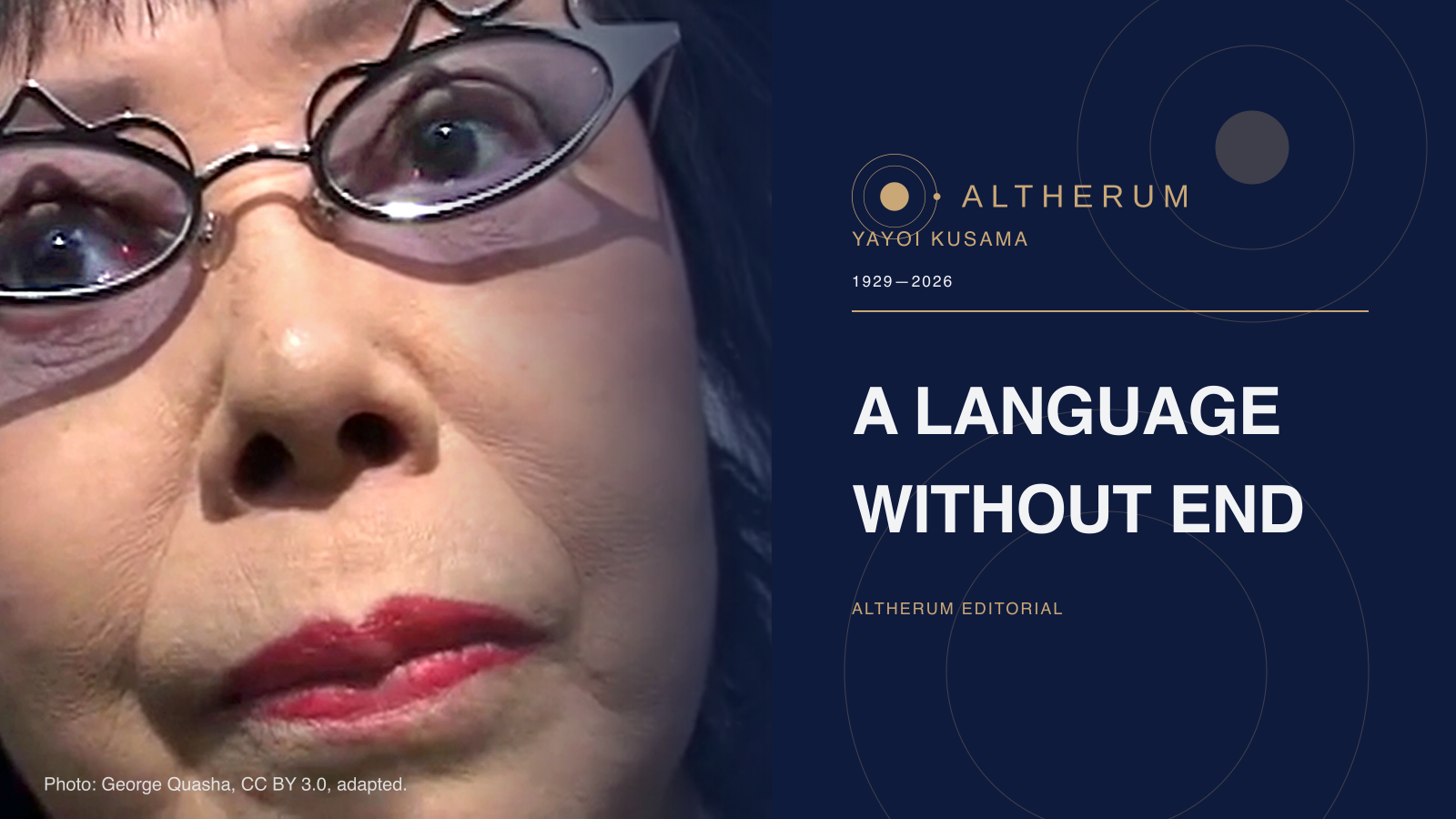
Yayoi Kusama died in Tokyo on 14 August 2026, aged 97. Her studio and the Yayoi Kusama Museum announced her death on 27 August. No cause was disclosed. The most respectful way to consider her legacy is not to speculate about what her death might do to prices, but to examine what she built over nearly eight decades: a visual language that remained unmistakably her own while moving from intimate drawings to paintings, sculpture, performance and immersive environments.
A private experience becomes a public language
Born in Matsumoto in 1929, Kusama described visions and hallucinations from childhood. Dots, nets and proliferating forms first appeared as a way of recording that experience. The significance of those motifs lies not merely in recognition. Through repetition, she turned private perception into a coherent artistic system—one capable of changing scale, medium and context without losing its identity.
She moved to the United States in 1957 and settled in New York the following year. Her early Infinity Nets replaced the dramatic gesture then associated with Abstract Expressionism with an almost obsessive accumulation of small arcs. The works had no obvious centre and no conventional endpoint. They made process itself visible and anticipated concerns that would later be associated with Minimalism, while remaining rooted in Kusama’s own experience.
From canvas to total environment
Kusama did not protect a successful motif by repeating it unchanged. She extended it. In the early 1960s, her soft sculptures covered furniture with multiplying forms. In 1965, Infinity Mirror Room—Phalli’s Field used mirrors to turn repetition into an environment around the viewer. The audience was no longer simply looking at infinity; it was placed inside an illusion of it.
Her 1966 Narcissus Garden sharpened the relationship between art, attention and commerce. At the Venice Biennale, without official invitation, she installed mirrored spheres and offered them to visitors for 1,200 lire each. MoMA PS1 later described the intervention as both self-promotion and a critique of the commercialisation of contemporary art. The episode matters because it shows that Kusama understood the market as a subject long before her work became a global market phenomenon.
Recognition arrived through continuity
After returning to Japan in 1973, Kusama continued to write fiction and poetry while producing sculpture, installations and paintings. International recognition deepened over time rather than appearing in a single moment. In 1993 she became the first woman to represent Japan at the Venice Biennale. The Yayoi Kusama Museum opened in Tokyo in 2017. Her honours included the Praemium Imperiale in 2006 and Japan’s Order of Culture in 2016.
Her later production was not a footnote to the earlier work. The My Eternal Soul series, begun in 2009 and continued until 2021, grew to roughly 900 paintings according to her official biography. It demonstrated a rare combination: relentless production and continuity of authorship without simple repetition.
What the market data does—and does not—say
Kusama’s market became international and deep across multiple media, periods and price levels. One highly visible benchmark came in May 2022, when her 1959 painting Untitled (Nets) sold at Phillips New York for US$10.496 million, including fees, then an auction record for the artist. In a separate report covering 2018–2022 sales at Christie’s, Phillips and Sotheby’s, ArtTactic and Sotheby’s placed Kusama among the leading artists in the US$1 million-plus contemporary auction segment.
Those figures are evidence of demand for particular works in particular transactions; they are not a universal valuation rule. Within a single artist’s market, medium, date, scale, condition, provenance, exhibition history, authenticity documentation and the specific series can produce radically different outcomes. Private sales are less transparent, auction results include different fee conventions, and a record result is not a representative average.
Nor does an artist’s death mechanically increase the value of every work. Future price formation depends on supply released to market, estate and studio governance, authentication, institutional programming, collector demand and the quality of each object. Kusama’s artistic importance was established during her lifetime. Her death changes the stewardship of that legacy; it does not replace due diligence.
A global market, but not a uniform one
Recent data makes the market’s scale—and its concentration—clearer. Hiscox’s HAT 100 analysis, which covered unique works made after 2000 and sold at Christie’s, Sotheby’s and Phillips, ranked Kusama as the top-selling contemporary artist in 2023 with US$80.9 million in auction sales; 80% of those works were sold in Hong Kong. A later report commissioned by Japan’s Agency for Cultural Affairs, using Artory and Artprice auction data, counted 799 Kusama lots sold worldwide in 2024 for US$146 million. Japan represented 35% of the lots but only 16% of value, while China, including Hong Kong, accounted for 48% of value and the United States 22%.
The same 2024 report recorded a 16% year-on-year decline in Kusama’s aggregate auction value, against a 36% contraction in the global contemporary auction market. That combination suggests resilience relative to the category, not immunity from the cycle. It also shows why geography matters: Japan produced the largest number of transactions, while the highest-value demand remained concentrated outside the domestic market.
Why one “average price” would mislead
Dividing the reported US$146 million of 2024 sales by 799 sold lots gives an arithmetic average of roughly US$183,000 per lot. It is a mathematically valid calculation but a poor guide to the value of an individual work. Kusama’s market ranges from widely circulated editions to unique early paintings and monumental sculpture, and the upper end has an outsized effect on the average.
A 2026 Artscapy analysis of 2,523 publicly reported auction results from 2018–2025 illustrates that dispersion. In 2025, prints and editions represented more than half of sold lots but only 11% of auction revenue; the five most expensive works generated 31% of annual value. Public results at the upper end vary materially too: Pumpkin (2022) realised US$6.8 million including premium at Christie’s New York in 2024, while Phillips London sold INFINITY-NETS (MAE) (2013) for £1.548 million and SPLENDOUR OF STARS CHANGING INTO BLUE (2019) for £322,500 in June 2026. These are transaction benchmarks, not interchangeable valuations.
A serious comparison therefore starts by separating unique works from editions, paintings from sculpture, early New York production from later series, and culturally central motifs from more abundant material. It then adjusts for dimensions, condition, date, provenance, exhibition history, publication history, authenticity documentation, edition size, buyer’s premium, currency and sale location. Median prices and like-for-like ranges are more informative than a blended average, but only when the underlying sample is sufficiently homogeneous.
What may shape the market from here
No responsible analysis can turn Kusama’s death into a simple price forecast. A base-case reading is that the market remains liquid but increasingly selective: historically important paintings, strong Infinity Nets and major pumpkin works may continue to attract global competition, while editions and more abundant later material remain more sensitive to supply and estimate discipline. A stronger scenario would require sustained museum programming, controlled releases, credible stewardship and continued demand across Asia, the United States and Europe. A weaker scenario could emerge if supply accelerates, authentication becomes less clear, the wider contemporary market contracts further or sellers anchor expectations to record prices that do not fit the object being offered.
These are scenarios, not predictions. The relevant question is not whether “Kusama will rise”, but which works retain cultural centrality, documentary strength and buyer depth under different market conditions.
Stewardship is part of value
Managing a Kusama work begins before acquisition. The file should reconcile title and ownership history, invoices, prior cataloguing, exhibition and publication references, authenticity documentation, condition reports and high-resolution images. Physical care must follow the medium: an acrylic painting, a sewn soft sculpture, a mirrored environment and an installation containing electrical or replaceable components do not share the same conservation, transport or installation requirements.
Professional custody should define environmental conditions, handling authority, inspection frequency, approved conservation interventions and incident reporting. Insurance should specify the valuation basis, geographic scope, transit cover and installation risks. For complex works, the documentation should also address installation instructions, components, authorised replacements and the rights attached to exhibition and image reproduction. Finally, an exit plan should identify realistic sale channels, likely transaction costs, timing and the depth of comparable demand rather than assuming immediate liquidity.
The Altherum lens: cultural importance before financial narrative
Kusama’s career offers a useful framework for thinking about collectible real assets. Durable cultural value tends to be supported by several interacting layers: a distinctive language; credible authorship; sustained innovation; critical and institutional recognition; documented provenance; and a market with enough depth to reveal meaningful comparables. None of these factors should be reduced to popularity alone.
For collectors and co-owners, the object must remain the starting point. That means examining authenticity and title, physical condition, conservation requirements, provenance, scarcity within the relevant body of work, exhibition and publication history, transaction costs, insurance, storage and realistic exit routes. The same artist name can sit on objects with very different quality and marketability.
Explore Altherum’s approach to collectible real assets and our framework for asset selection and valuation.
Kusama made repetition a way to speak about infinity, identity, fear, love and disappearance. The global recognition that followed was not created by a logo or a single record sale. It was built through decades of coherent work, continual reinvention and institutional engagement. That is the deeper lesson of her legacy: price can record demand at a moment in time, but cultural value is constructed slowly—and must be understood work by work.
This article is for cultural and educational purposes only. It is not investment advice and does not indicate that any work by Yayoi Kusama is available through Altherum.
Sources
- Yayoi Kusama Museum, official announcement, 27 August 2026
- Yayoi Kusama official biography
- Hirshhorn Museum and Sculpture Garden, artist overview
- MoMA PS1, Narcissus Garden
- Phillips, Untitled (Nets) lot record, and New York Evening Sale results, 18 May 2022
- ArtTactic and Sotheby’s, The $1m+ Contemporary Market (2018–2022 data; published 2023)
- Hiscox, HAT 100 market findings, 4 April 2024
- Agency for Cultural Affairs, Japan, The Art Market in Japan 2025, Arts Economics analysis of 2024 data
- Artscapy, From prints to trophies, 2018–2025 auction dataset, published 2026
- Phillips, London Modern & Contemporary Art results, 26 June 2026