
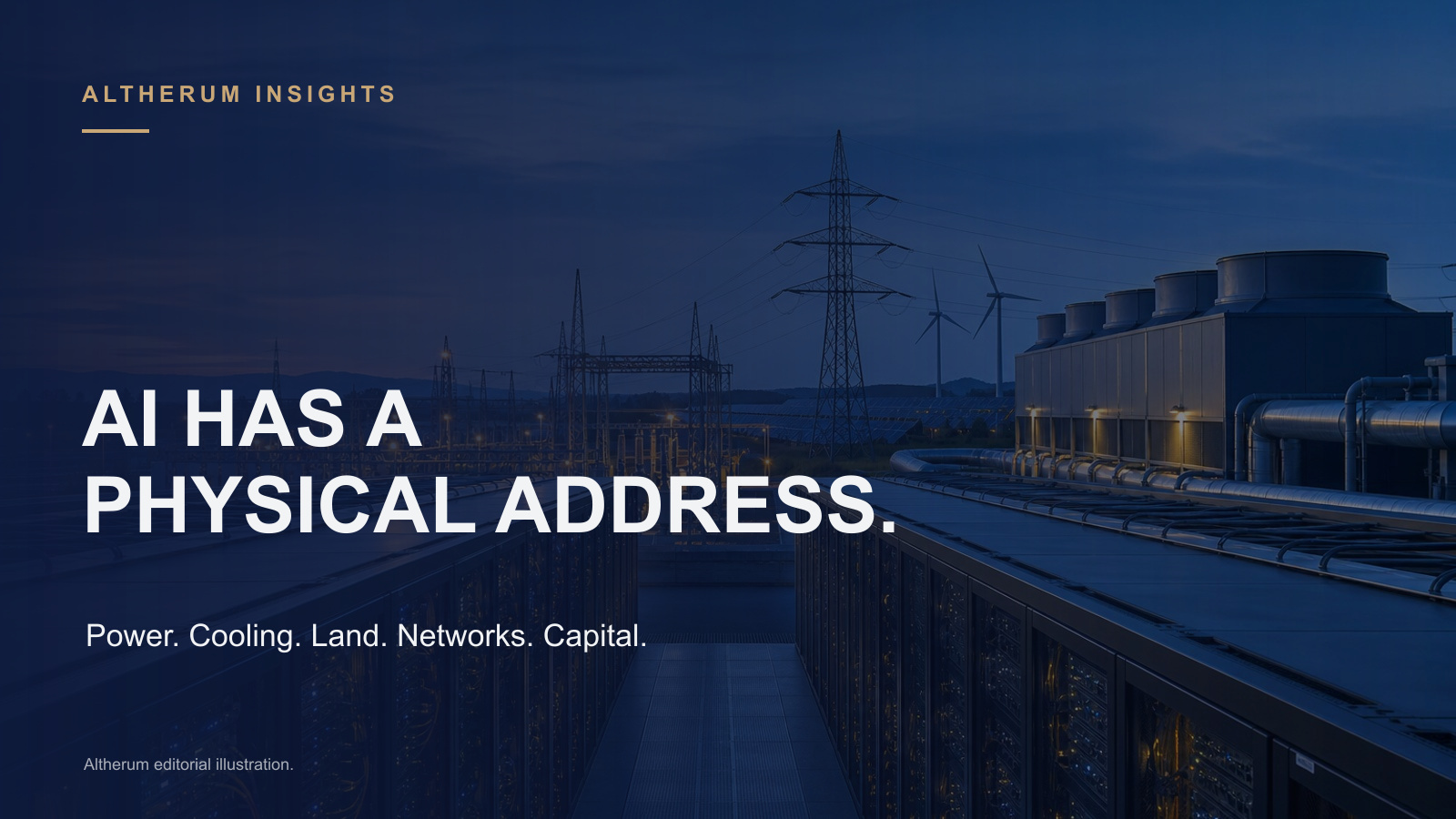
Artificial intelligence is experienced through software, but delivered by physical systems. Every prompt travels through chips and servers housed in data centers, connected by fiber, cooled by engineered systems and supplied with electricity. Before a model can scale, someone must secure land, permits, grid capacity and long-duration capital.
This physical layer is becoming more visible. The International Energy Agency’s 2026 update estimates that global data-center electricity consumption could rise from roughly 485 TWh in 2025 to about 950 TWh in 2030. The IEA also expects electricity demand from AI-focused data centers to more than triple over that period. These are projections, not certainties, but they reveal the scale of the infrastructure question.
For Altherum, that physical stack is a potential origination map for selected private-equity and club-deal opportunities—not a reason to follow the AI label indiscriminately. A data centre, an energy platform or a cooling business becomes relevant only when the underlying project, sponsor, economics and governance can withstand deal-specific analysis.
Compute is only the first constraint
The public conversation often starts with advanced chips. Yet chips do not operate in isolation. They require server capacity, high-density buildings, reliable power, cooling, maintenance and network connectivity. A shortage at any layer can delay or impair the entire system.
Power availability is not the same as power potential
A region may possess abundant generation resources while still lacking an available grid connection at the required location and time. Interconnection queues, transmission capacity, redundancy standards and local permitting can determine whether a data-center project becomes operational or remains theoretical.
Cooling changes the map
High-performance computing produces intense heat. Cooling design affects operating efficiency, water requirements, site selection and community impact. The right solution depends on climate, equipment density, energy pricing and regulation. There is no single infrastructure template that works everywhere.
Contracts determine who captures value
Demand growth does not automatically make every asset attractive. Investors must examine the durability of customer commitments, concentration risk, power-purchase arrangements, construction obligations, escalation clauses, financing terms and residual technological risk. A compelling theme can still produce a weak asset if the contractual structure is poor.
Capital must arrive before capacity
Data centers, grid upgrades and generation assets require substantial upfront investment. The IEA notes that capital markets will play a critical role in financing this expansion. For private-market investors, that creates an opportunity set spanning infrastructure, energy, real estate and specialized services—but also a need for disciplined underwriting across sectors.
What could fit an Altherum club-deal thesis?
The most credible candidates are not defined by a fashionable label. They may include an operating platform expanding contracted capacity, a project with secured land and grid access, or a specialized provider solving a measurable bottleneck in power, cooling or connectivity. In each case, Altherum would need to assess the sponsor, governance rights, capital expenditure, permits, customer concentration, contractual revenues, downside protection and credible exit routes before deciding whether an opportunity merits selection.
This is an equity and governance question when structured as a private-equity club deal. A project bond or other private-debt instrument would require a separate analysis of issuer, security, repayment sources, covenants and pricing. The two structures should never be presented as interchangeable.
The better investment question is therefore not simply whether AI will grow. It is whether a specific private-market project solves a genuine bottleneck, has a defensible claim on the value created and can be structured with an appropriate alignment of interests.
AI may live in the cloud. Its economics are built on the ground.
Internal links: How real assets are selected and valued · The role of due diligence in alternative investments
Sources: International Energy Agency, *Key Questions on Energy and AI* (2026) and *Energy and AI* (2025).